Munich Fabric Start 2027: a sourcing guide
20–22 January 2027 at MOC – Event Center Messe München, Munich, Germany. Munich Fabric Start is an international fabric and accessories trade fair organised by Munich Fabric Start Exhibitions GmbH. It brings together professional visitors and suppliers around fabrics, accessories, textile finishing and sourcing solutions for fashion and apparel. The organiser says exhibitors will present collections and innovations for the Spring/Summer 2028 season. For visitors, the practical purpose is to compare materials, ask precise questions and connect product discovery with decisions about upcoming collections.
Why Munich Fabric Start matters to textile professionals
Discover materials in context
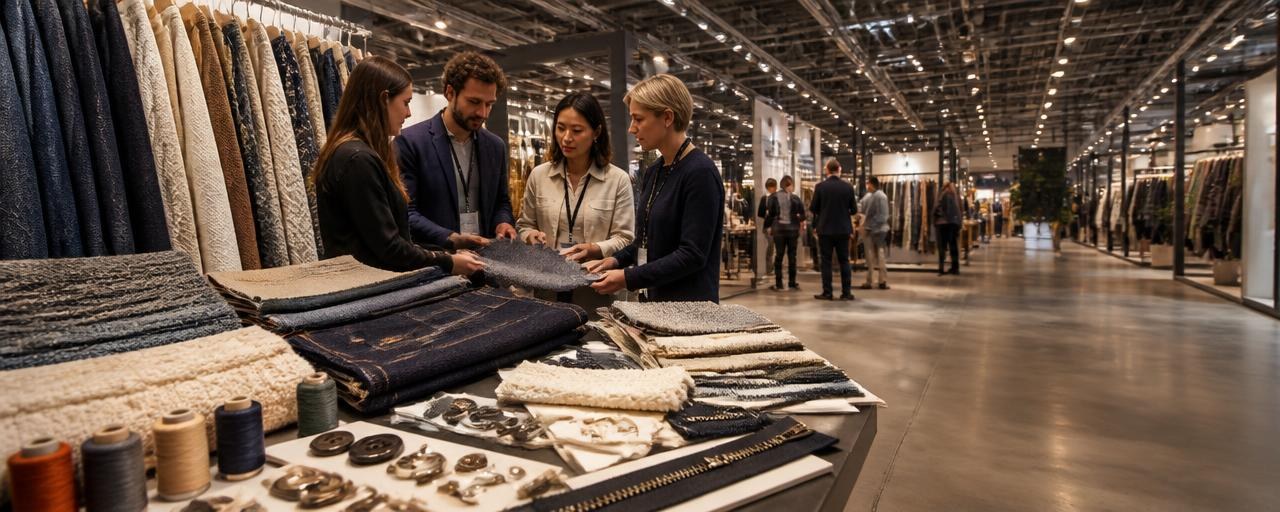
Material selection depends on more than colour or appearance. Weight, handle, construction, finish, end use, availability and supplier capability can all affect whether a fabric or component fits a collection. At a sourcing fair, visitors can examine samples directly and discuss those points with suppliers rather than relying only on catalogue descriptions.
Compare options before committing
Buyers and product managers can use the show to compare materials across suppliers, note differences in specification and shortlist options for further review. Designers can assess texture, colour and construction against a collection concept. The fair is most useful when visitors arrive with clear product needs and record what must be checked after the event.
Connect design and sourcing
Munich Fabric Start combines fabric and accessory sourcing with areas that the organiser identifies for denim, design, sourcing and sustainable innovations. This breadth can help visitors consider how a material decision relates to trims, finishing, product identity and the broader collection brief.
Who should visit Munich Fabric Start?
Fashion and textile buyers
Useful if you are reviewing suppliers or building a sourcing shortlist for an upcoming collection. Compare material quality, construction and finish side by side; record the supplier, sample reference, minimum-order information and next question for each option. Verify commercial terms and availability directly with the supplier after the fair.
Fashion designers and collection developers
Useful if you need to translate a design direction into workable materials. Examine how colour, surface, drape, weight and construction support the intended garment or product. Keep a brief for each sample so that an attractive swatch remains connected to its intended use, target customer and technical requirements.
Product managers and sourcing professionals
Useful if you coordinate design intent with supplier capability, product development and purchasing decisions. Use conversations to clarify specifications, development steps, sourcing options and information still needed from each supplier. Distinguish an initial discussion from a confirmed commercial offer.
Denim and sportswear professionals
Useful if your work involves denim, washes, finishes or materials for streetwear and sportswear. The organiser identifies BLUEZONE as part of the show and highlights denim within its offering. Compare options against the performance, appearance and end-use requirements of your products, then capture any testing or compliance questions for follow-up.
Textile manufacturers and material suppliers
Useful if you want to present fabrics, accessories, finishing or sourcing capabilities to fashion-industry professionals. Before deciding how to exhibit, define which buyer or design problem your products address and what evidence visitors need to assess their suitability. The organiser provides exhibitor information and an application route; confirm current participation conditions with it.
What can you find at Munich Fabric Start?
Fabrics and apparel materials
The organiser describes fabrics as a core part of the show and refers to new materials and collections for fashion and apparel. Visitors may compare woven and knitted material options, assess surface and construction, and ask suppliers about suitable applications, sampling and development. Confirm product specifications and availability directly with each supplier.
Accessories and trims
The Additionals area is listed by the organiser alongside the fabric offer. This gives collection teams a reason to consider components and finishing details as part of a complete product brief. When comparing trims or accessories, note dimensions, material composition, colour references, attachment method and any compatibility requirements relevant to the product.
Denim and sportswear
BLUEZONE is the organiser’s denim-focused area. It is relevant to professionals assessing denim materials and related innovations. For each option, record the fabric construction and finish, the intended product, the sample reference and any wash, performance or production questions that need technical confirmation.
Design, sourcing and innovation areas
The organiser also lists Design Studios, Keyhouse, ReSOURCE, Sustainable Innovations and The Source. Their names indicate additional routes through the fair’s design, sourcing and innovation offer; check the current official area descriptions and event information to understand the focus of each before planning your visit. Do not assume that every previous-edition feature or exhibitor will return in the same form.
What makes Munich Fabric Start distinctive?
It brings fabric and accessory sourcing together with dedicated areas for denim, design and material innovation. The organiser describes the fair as a business platform for the fashion and textile industry and presents BLUEZONE as an integral part of its offer. This combination can be useful when a collection decision spans more than a base fabric—for example, when designers and buyers need to consider materials alongside trims, finishing or sourcing alternatives. The value still depends on the relevance of the participating suppliers and on checking each product against your own brief.
What should you try to achieve at Munich Fabric Start?
If you are a buyer
Leave with a short, prioritised list of material options to evaluate. For each candidate, capture the supplier, sample identifier, specification, intended use and the information still required before approval. Separate a promising sample from a verified source that meets your commercial and technical conditions.
If you are a designer
Identify materials that support a defined collection direction. Record why each swatch fits, what garment or product it could serve, and which colour, finish or construction detail needs development. Keep alternatives where a concept depends on one uncertain material choice.
If you work in denim or sportswear
Compare a focused set of materials against the use case. Note the construction, finish, target performance and any testing or wash questions. Ask suppliers what documentation or samples are available for the next stage of evaluation.
If you exhibit
Make it easy for the right visitor to understand product fit. Prepare concise specifications, clear sample references and answers to common questions about applications, development and next steps. Define what a useful follow-up would be for your business rather than treating general interest as a qualified opportunity.
How to prepare before Munich Fabric Start
1. Write a sourcing or design brief
List the products you are developing, the material qualities you need, the intended end use and the main constraints. For example, specify desired weight or handle, construction, finish, colour range, target performance and delivery requirements where those are relevant to your project. Mark which requirements are essential and which can change.
2. Build a priority list
Use the organiser’s Brand Search and Material & Supplier Search tools, where available, to identify relevant companies before arriving. Group them into three tiers: A for essential conversations, B for useful comparisons and C for options to explore if time allows. Check current listings and availability with the organiser rather than assuming an earlier listing is current.
3. Prepare supplier questions
- Which product construction and composition apply to this sample?
- What is the fabric weight, width, finish or other key specification?
- Which applications or garment types is it designed to serve?
- Can the material be developed in the colours or finishes required?
- What sampling and product-development steps are available?
- What are the minimum order, lead time and availability, and how may these vary?
- Which certifications or supporting documents apply to this particular product?
- What information do you need from us to assess a project?
- Are compatible trims, finishing or alternative constructions available?
- Who should receive the technical brief and what is the agreed next step?
4. Set meetings and leave comparison time
Contact priority suppliers in advance if you need a detailed discussion. Do not fill every available minute with appointments: allow time to compare samples, visit relevant areas and follow an unexpected lead. Keep a buffer for conversations that need more technical detail than a quick introduction allows.
5. Plan registration and practical arrangements
The organiser provides visitor-ticket registration through its website and describes a personal visitor account for the upcoming show. Review the current registration conditions, opening information and travel arrangements before setting your plan. The official MFS app is described as providing key event information and practical functions; check that its information relates to the current edition.
How to make the most of the exhibition
Use a consistent record for every sample or supplier: Company → Product or sample → Why it fits → Open questions → Contact → Next action. Photograph or label samples only in accordance with the supplier’s guidance, and make sure the reference can be matched to the company after the show.
Compare products against the same criteria rather than relying on memory. A compact note might include construction, weight or handle, finish, colour, intended application, sourcing requirement and missing technical information. If several people from your team attend, agree on one shared record format and assign responsibilities so that duplicate conversations do not replace coverage of priority suppliers.
Use the organiser’s app and search tools as aids to navigation and discovery, not substitutes for checking details directly. When a product seems suitable, ask what evidence, samples or commercial information the supplier can provide after the event. Make the next step explicit before moving on.
Plan your time realistically at Munich Fabric Start
The show runs across three days and includes multiple named areas. The best plan depends on how many product groups matter to you and how much time supplier discussions require. A focused visit should prioritise the areas and conversations tied to your brief rather than trying to cover every display.
Before the day
Place essential suppliers and areas at the top of your list. Check the latest event information and app, and group your priorities so that you can adapt if a meeting changes. Keep a secondary list for products that are interesting but not central to the current collection.
During the visit
Start with priority conversations while you have time to ask detailed questions. Use a short review point later in the day to compare notes, identify gaps and decide which suppliers need a second conversation. Save time for the areas most relevant to your brief instead of collecting samples without a decision framework.
At the end of each day
Sort notes into immediate follow-up, further evaluation and general market information. Confirm that sample references and supplier contacts are complete. Update the next day’s priorities based on what you learned, without discarding technical questions that remain unresolved.
Travelling to Munich Fabric Start
The event is at MOC – Event Center Messe München, Lilienthalallee 40, in Munich. The organiser’s visitor information gives driving directions via the Munich-Freimann exit and identifies the A9 and A99 connections. Messe München’s venue information describes the MOC as being in the north of Munich and provides address and route details. Check current road, public-transport and venue guidance before travelling, as arrangements can change.
The organiser and venue provide arrival information for visitors travelling by car, plane, train and public transport. Use the current official directions and local transport planner to check the best route for your starting point. Underground parking information is provided by the organiser; confirm current access and terms before relying on it.
One day or several days at Munich Fabric Start?
A single day may suit visitors with a narrow sourcing brief, a short list of priority suppliers and one or two product areas to compare. Allow enough time to inspect samples and discuss specifications rather than planning only for rapid stand visits.
Two days may be more practical if your work spans fabrics, accessories and denim, or if you need meetings as well as independent product comparison. A third day can help visitors with broader research or a larger set of supplier discussions, but the decision should reflect your priorities and the current programme and opening details, which should be checked with the organiser.
Munich Fabric Start for a live collection project
If you are sourcing for a current development, bring a concise brief that you can share with suppliers. Include product type, intended use, target material qualities, colour direction, estimated quantities or order range if known, development timing and any documentation requirements. You do not need to disclose confidential design information to begin a conversation; share only what is appropriate.
For each promising material, note the sample reference and the next validation step. That may involve reviewing a technical sheet, checking colour or finish, assessing suitability with your product team, or confirming commercial terms. Treat each of those as a follow-up task rather than an assumption that a brief conversation has resolved it.
After Munich Fabric Start: turn samples into decisions
Review notes promptly while the conversations are still clear. Sort contacts into three groups: A — immediate follow-up for materials directly relevant to a current project; B — further evaluation for options that need samples, specifications or internal review; and C — market intelligence for ideas to keep for later collections.
For A and B contacts, send a focused follow-up that identifies the product or sample discussed, the information you need and the next action. Depending on the product, this may include technical specifications, composition, colour options, test documentation, sampling arrangements, minimum order, lead time or commercial terms. Compare alternatives on the same criteria and retain the reason each sample was shortlisted or rejected.
For exhibitors, follow up with the agreed material information and a clear question about the visitor’s application or next decision. Keep a record of requests and responses so that potential interest can be assessed on evidence rather than treated as a confirmed order or partnership.
Who should consider exhibiting at Munich Fabric Start?
The show is relevant to companies offering fabrics, textile accessories, denim-related materials, textile finishing, sourcing solutions and innovations for fashion and apparel. The organiser lists dedicated areas that include Fabrics, Additionals, Bluezone, Design Studios, Keyhouse, ReSOURCE, Sustainable Innovations and The Source. Companies should confirm current exhibitor eligibility, area fit and participation conditions directly with the organiser.
Before applying, define the audience you want to reach and the products you intend to present. Prepare clear sample identification, product specifications and supporting documents that help visitors judge fit. Decide what a useful business conversation would establish: an application, a technical requirement, a sample request or a defined follow-up. The organiser provides exhibitor information and an application route; current terms and deadlines should be checked directly.
Munich Fabric Start visitor checklist
Before
- ☐ Define the collection, product or sourcing problem you want to address.
- ☐ Prioritise suppliers and the event areas relevant to your brief.
- ☐ Register through the current visitor process and check your account details.
- ☐ Prepare consistent product questions and a way to record sample references.
- ☐ Check current dates, opening information, app details and travel guidance.
During
- ☐ Compare materials against the same specifications and end-use needs.
- ☐ Record supplier, sample, product fit, missing information and next action.
- ☐ Confirm which claims or documents need independent or technical review.
- ☐ Revisit priority suppliers if an important question remains unanswered.
- ☐ Keep samples and notes clearly connected to their source.
After
- ☐ Sort contacts into immediate follow-up, evaluation and market learning.
- ☐ Request the specific samples, specifications or terms needed for a decision.
- ☐ Compare options with your team and document why each is shortlisted.
- ☐ Record agreed next steps and follow up with suppliers promptly.
Is Munich Fabric Start worth visiting?
Munich Fabric Start is most relevant to fashion and textile professionals who need to source, compare or develop fabrics, accessories and related materials. Buyers can use the show to structure supplier comparisons; designers can assess materials directly; product and sourcing teams can connect product requirements with supplier discussions. The named areas for fabrics, accessories, denim, design and innovation offer useful ways to focus a visit.
The return depends on preparation. Visitors who define material requirements, prioritise conversations and capture specifications are better placed to turn product discovery into considered follow-up. A visit without a brief may still provide inspiration, but it is less likely to answer a specific sourcing or collection question.
Munich Fabric Start 2027 at a glance
| Item | Information |
|---|
| Event | Munich Fabric Start |
| Dates | 20–22 January 2027 |
| City and country | Munich, Germany |
| Venue | MOC – Event Center Messe München, Lilienthalallee 40, 80939 Munich |
| Organiser | Munich Fabric Start Exhibitions GmbH |
| Main subjects | Fabrics, textile accessories, denim, textile finishing and sourcing solutions |
| Relevant audiences | Fashion and textile buyers, designers, product managers, sourcing professionals and material suppliers |
| Collection season highlighted | Spring/Summer 2028 |
| Visitor information | Visitor registration, an MFS app and search tools are provided by the organiser; check current details before attending. |
The organiser’s current event information confirms the dates, venue and collection season. Check the organiser’s website for any further programme, opening or participation details before making final arrangements.
Make your Munich Fabric Start visit count
Choose the material decisions you need to make, then use the show to discover, compare and ask better questions. Keep every sample connected to its source and finish with a clear next step. Source. Compare. Specify. Follow up.
For further information, please click
here .